Learn how to optimise content for Google Gemini and AI Overviews. Simple GEO techniques, schema markup, and formatting rules to get featured in Google AI search.
If you want your content to appear in Google AI Overviews, the foundation is still strong SEO: make the page crawlable, indexable, useful, trustworthy, and easy to understand. The key difference is that your content now needs to work well when Google’s AI systems identify relevant passages, connect information from multiple searches, and present supporting links in an AI-generated answer.
This guide explains how to optimise content for Google Gemini, improve your chances of appearing in Google AI Overviews, and build content that is useful across modern Google Search experiences. The goal is not to write “for AI” in a robotic way. Create genuinely helpful content that Google can understand, retrieve, and confidently connect to users’ questions.
What Are Google AI Overviews and How Do They Work?
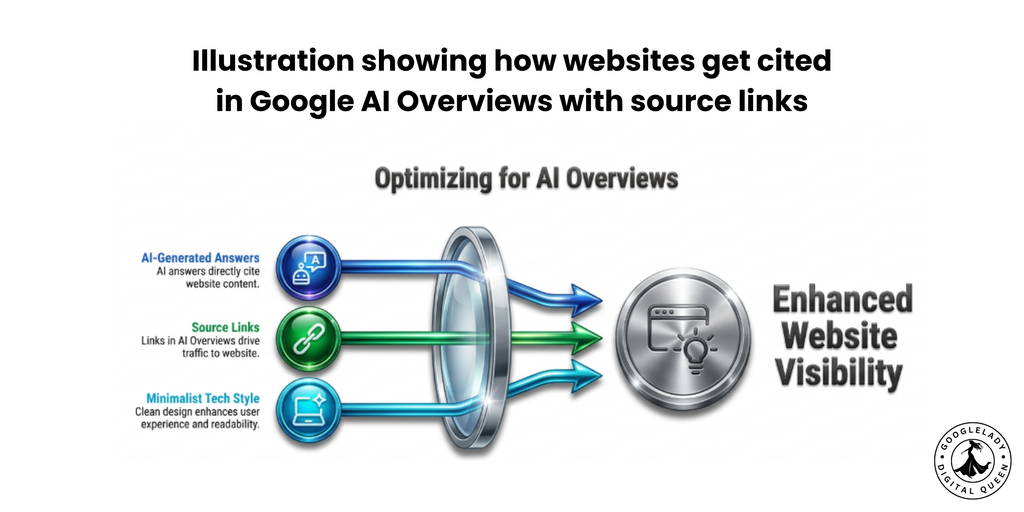
Google AI Overviews are AI-generated summaries that can appear at the top of Google Search for certain queries. Instead of making users open several individual search results, an AI Overview can summarise relevant information and link to supporting web pages.
Google describes AI Overviews and AI Mode as part of the evolving Search experience. They can use different models and techniques, so the links shown can vary by query and search context.
For website owners, the important point is simple: traditional SEO still matters. A page generally needs to be indexed and eligible to appear in a Search snippet before it can count as a supporting link in Google's AI features.
That means no separate trick replaces SEO.
You still need:
- A technically accessible website
- Crawlable pages
- Search-engine indexability
- Helpful and reliable content
- Clear site structure
- Strong internal linking
- Good page experience
- Original information and expertise
- Content that directly satisfies search intent
How Google AI Overviews retrieve and display information
Imagine someone searches:
“How long does SEO take to work for a small business?”
A traditional search page may display several blue links, advertisements, local results, videos, and other features.
An AI-powered Search experience can take the question further. Google may interpret the main question, identify related subtopics, retrieve information from multiple sources, and construct a response that addresses several aspects of the query.
This is where query fan-out becomes important.
Google explains query fan-out as a process in which its AI systems run multiple related searches to explore different aspects of a complex question. For example, a search about buying a laptop could lead Google to investigate specifications, battery life, pricing, reviews, and competing models.
For content creators, this means one page can potentially become relevant to several connected questions.
Instead of writing an article that answers only:
“What is SEO?”
you could build a comprehensive resource that also addresses:
- How SEO works
- How long SEO takes
- What affects SEO results
- Technical SEO basics
- On-page SEO
- Off-page SEO
- Local SEO
- SEO costs
- Common SEO mistakes
- How to measure SEO performance
The key is not to create a separate page for every tiny variation. Google specifically advises publishers to focus on useful, original content rather than producing many pages to capture AI-related query variations.
The difference between AI Overview citations and traditional rankings
Traditional Google Search rankings and AI Overview visibility are related, but they are not identical.
A traditional ranking answers:
“Where does this page appear in the search results?”
AI Overview visibility asks something different:
“Does Google consider this page useful as a supporting source for this particular AI-generated response?”
A page might rank well for a traditional query but not be selected as a supporting source for every AI-generated answer related to that topic.
Likewise, a page that does not rank at the very top for every variation can still provide useful information for a specific part of a broader AI-generated response.
That is why Google AI Overviews optimisation shouldn't be treated as a replacement for normal SEO. It should be treated as an extension of good Search practices.
Why snippet eligibility matters for AI Overviews inclusion
One of the most important technical points is often overlooked.
Google says a page must be indexed and entitled to appear in Google Search with a snippet to qualify as a supporting link in AI Overviews or AI Mode.
So before worrying about sentence structure, keywords, or AI extraction, check the basics.
Ask:
- Is the page indexed?
- Does robots.txt block it?
- Does it contain a noindex directive?
- Can Google access the page?
- Is important content available as text?
- Are internal links pointing to the page?
- Is the canonical URL correct?
- Does the page meet Google's Search policies?
- Is the site included in Search generative AI features?
A technically blocked page cannot become a strong AI Overview candidate simply because the writing is excellent.
How Google Chooses Sources for AI Overviews (2026 Research)
No publicly documented Google formula says exactly why one website is cited instead of another for every AI Overview.
So avoid SEO claims such as “Google gives exactly X% weight to author expertise” or “this word count guarantees AI citations.”
A better approach is to understand the process conceptually.
The four-stage selection process: eligibility, retrieval, matching, citation
A useful way to think about AI Overview source selection is through four broad stages.
1. Eligibility
The page must first be accessible, indexed, and eligible for Search snippets.
2. Retrieval
Google's systems must find potentially useful information across its Search ecosystem.
3. Matching
The retrieved content must match the user's question and the specific information Google is trying to provide.
4. Citation
Google may then use selected pages as supporting links within the generated experience.
This is not a publicly published four-step ranking formula. It is a practical framework for understanding the process.
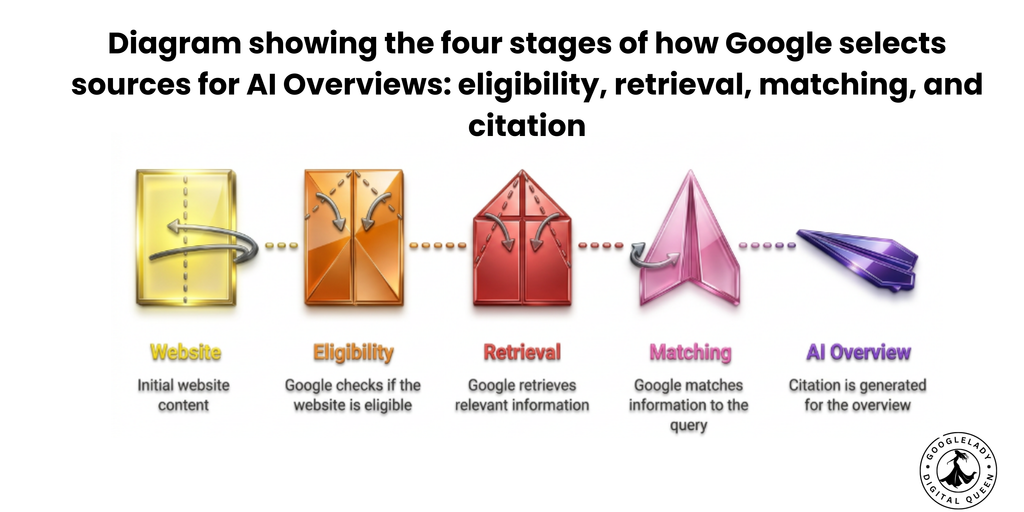
The takeaway is important: simply publishing a page does not mean Google will cite it.
Your content has to be accessible and useful for the specific question.
Why query fan-out creates multiple ranking opportunities
Query fan-out changes how you should think about keyword research.
Consider the search:
“How can I improve my website speed?”
The user may actually need answers about:
- Core Web Vitals
- Image optimization
- JavaScript
- CSS
- hosting
- caching
- mobile performance
- server response time
- CDN usage
Google can explore these related concepts when generating an answer.
That creates multiple opportunities for a genuinely comprehensive article.
However, don't create 20 nearly identical articles such as:
- How to improve website speed
- How to improve site speed
- How to make a website faster
- How to increase website loading speed
- How to improve website performance
If the information is essentially identical, those pages may add little value.
A better strategy is to create one authoritative resource and cover the meaningful subtopics naturally.
How E-E-A-T and author expertise influence Google AI Overview citations
E-E-A-T stands for:
- Experience
- Expertise
- Authoritativeness
- Trustworthiness
Google does not publish a simple E-E-A-T score that determines whether a page will receive an AI Overview citation.
Still, trust and quality matter enormously when you are creating content that people may rely on.
For example, compare two articles about financial planning.
One is anonymous and makes broad statements without sources.
The other identifies the author, explains their relevant professional background, cites reliable data, explains limitations, and clearly separates facts from opinions.
The second page gives readers more reasons to trust the information.
This is crucial for topics like health, finance, law, and safety, where inaccurate information can lead to real-world harm.
Add useful trust signals such as:
- A genuine author byline
- Relevant author credentials
- An author profile
- Editorial information
- Original research
- First-hand experience
- References to reliable sources
- Clear publication dates
- Visible update dates when appropriate
- Transparent methodology
- Contact information where appropriate
Don't add credentials to make a page look authoritative. They should be genuine and relevant.
The role of structured data in Google AI search features
Structured data helps Google understand certain types of content and can support eligibility for specific Search features.
For example, Article structured data can communicate information such as:
- Article headline
- Author
- Publication date
- Modified date
- Images
But there is an important distinction.
Structured data does not guarantee an AI Overview citation.
Google explicitly states that there is no special schema markup required for generative AI Search features.
So don't waste time looking for a magical “AI Overview schema.”
Instead, use appropriate structured data as part of your broader technical SEO strategy, make sure it matches the visible content, and validate it properly.
Step-by-Step: How to Optimise Content for Google AI Overviews
Now let's move from theory to implementation.
Ensure your page is indexed and eligible for snippets.
Start with Google Search Console.
Use URL Inspection to check whether the page is indexed and accessible.
Look for problems involving:
- Crawling
- Indexing
- Canonicalization
- Noindex directives
- Robots.txt
- Mobile usability
- Server errors
Also review your site's Search generative AI settings where available.
As of August 31, 2026, Google has rolled out its Search Console generative AI performance reporting to websites worldwide. The report provides data about impressions generated from AI features in Google Search, including AI Overviews and AI Mode.
This gives publishers a much better way to understand whether their content is being surfaced in generative Search experiences.
Answer the primary question in the first 40–60 words.
This is a practical editorial recommendation, not a Google requirement.
If someone searches:
“What is local SEO?”
Don't spend the opening 150 words talking about the history of the internet.
Answer the question immediately.
For example:
Local SEO refers to the strategic process of boosting a company's visibility for users performing geographically targeted searches. It helps businesses appear when nearby customers search for products or services, particularly through Google Search and local business results.
Then expand.
This approach helps both humans and search systems because the page's purpose becomes clear immediately.
Use question-based H2s that match real user queries.
Question-based headings can make a long article easier to navigate.
Instead of:
“Important Factors”
try:
“What Factors Affect Local SEO Rankings?”
Instead of:
“Implementation Process”
try:
“How Do You Implement Local SEO?”
This doesn't mean every heading must exactly match a keyword.
Write naturally.
Good headings should help readers understand what they will learn next.
Add original data, statistics, and verifiable claims.
AI systems have plenty of access to generic information.
What makes your content more valuable?
Original information.
Consider adding:
Survey results
Customer research
First-party data
Original experiments
Case studies
Before-and-after results
Expert interviews
Screenshots
Industry observations
Calculations
Unique examples
For example, instead of saying:
“Page speed is important for SEO.”
Explain what you observed after improving page speed on a real website.
What changed?
- Organic impressions
- Conversion rate
- Engagement
- Bounce-related metrics
- Revenue
- Mobile performance
Specific evidence makes content more useful than another generic paragraph.
Build comparison tables and bulleted lists for easy extraction.
Tables are especially useful when users need to compare options.
For example:
| Crawlability | Important | Important |
| Indexing | Essential | Essential |
| Search intent | Important | Important |
| Helpful content | Important | Important |
| Original insights | Valuable | Highly useful |
| Structured data | Useful where applicable | No special AI schema required |
| Author transparency | Useful | Supports trust |
Use tables when they genuinely improve understanding.
Don't turn every article into a table simply because you want search engines to extract information.
Google Gemini and AI Overviews SEO Checklist: 12 Actions
Use this checklist when publishing or updating content.
1. Check Search Console for indexing and snippet eligibility
Confirm that Google can access and index the page.
2. Implement Article, FAQPage, and HowTo schema where appropriate
Use structured data only when it accurately represents the visible content and when the format is appropriate for the page.
Don't add schema simply because you think it will force an AI citation.
3. Display visible author bylines with real credentials
Make it easy for readers to understand who created the content.
4. Add “Last Updated” dates for time-sensitive content
For topics involving statistics, software, pricing, regulations, or changing technology, update information when necessary.
Don't change dates without actually improving the content.
5. Create 20–30 target queries and track AI Overview appearances
Build a practical query set around your main topic.
For example, an SEO agency might track:
- What is SEO?
- How does SEO work?
- How long does SEO take?
- How much does SEO cost?
- Is SEO worth it?
- What is technical SEO?
- What is local SEO?
- How does Google rank websites?
Check these queries regularly and record:
- Date
- Query
- AI Overview present?
- Your page cited?
- Competitor pages cited?
- Your traditional ranking
- Notes about the AI response
6. Monitor AI Overview referral traffic in GA4
Look for traffic originating from Google AI experiences where identifiable.
Don't expect every AI interaction to produce a click.
An AI answer can satisfy part of the user's question without requiring them to visit a website.
7. Strengthen internal linking
Connect related pages naturally.
A comprehensive topic cluster helps users discover supporting content and helps search engines understand relationships between pages.
8. Add first-hand experience
Explain what you actually tested, observed, built, measured, or learned.
9. Remove unsupported claims
If you say:
“This strategy increases conversions by 40%.”
you should have evidence for that statement.
10. Update outdated information
Review old statistics, screenshots, product information, pricing, dates, and examples.
11. Improve content that only repeats existing information
Ask:
“What does this article provide that the next five search results don't?”
If the answer is “nothing,” the page needs more original value.
12. Keep the reader—not the algorithm—at the centre
Google's own guidance emphasises helpful, reliable, people-first content.
That principle is more useful than trying to reverse-engineer every AI system.
Technical Requirements for Google AI Search Optimisation
Crawlability and indexability fundamentals
Technical SEO remains the foundation.
Check:
- robots.txt
- XML sitemap
- Canonical tags
- HTTP status codes
- Noindex directives
- Internal links
- Mobile accessibility
- Page experience
- Server availability
If Google cannot properly discover and process your content, content optimisation cannot compensate.
Server-rendered HTML vs. JavaScript content
JavaScript is not automatically bad for SEO.
Modern search engines can process JavaScript.
The problem occurs when important information is difficult to access, rendered inconsistently, delayed, or unavailable in the page's accessible content.
For important content, make sure the meaningful information is available in the rendered page and not hidden behind unnecessary interactions.
For example, don't put the main answer exclusively inside a JavaScript widget that fails to render correctly.
Structured data best practices for AI extraction
Use structured data where it makes sense.
For a blog article, Article or BlogPosting markup may help communicate:
- Author
- Headline
- Dates
- Images
For other content types, use the appropriate supported structured data.
Remember:
Structured data describes content. It does not replace quality content.
Also ensure structured data matches what users can actually see on the page.
Internal linking and topical authority signals
Suppose you have an article about:
“Google AI Overviews SEO.”
You might naturally connect it to:
- Technical SEO
- Search intent
- Content optimization
- E-E-A-T
- Keyword research
- Internal linking
- Google Search Console
- Schema markup
This creates a useful topical ecosystem.
Instead of publishing dozens of disconnected articles, build a collection of resources that genuinely support one another.
Content Formatting Rules for AI Overview Citations
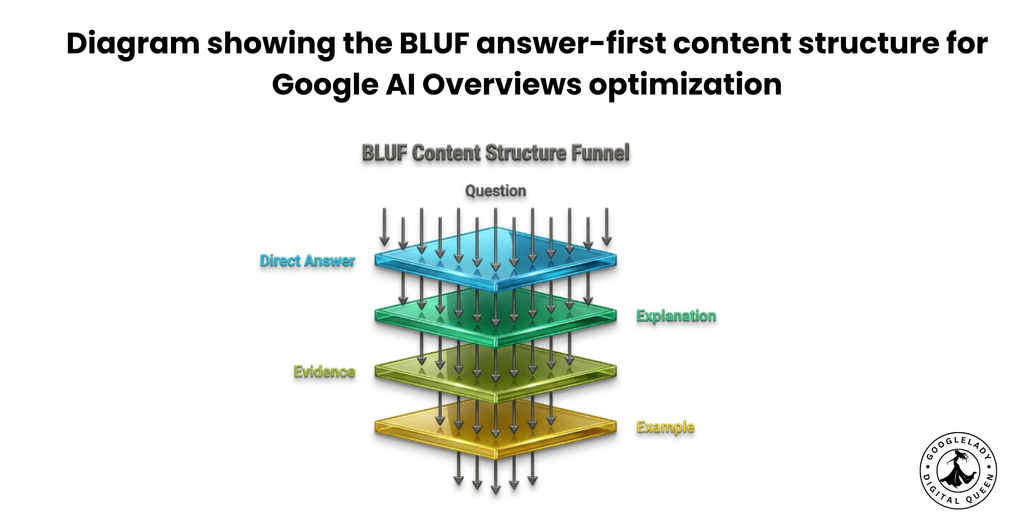
Answer-first structure (BLUF: Bottom Line Up Front)
BLUF means Bottom Line Up Front.
Give readers the answer before the lengthy explanation.
A useful structure is:
Direct answer → Explanation → Evidence → Example → Additional details
For example:
SEO helps businesses increase organic visibility by improving how their websites satisfy search intent and meet search-engine quality and technical requirements.
Then explain how.
Don't make the reader dig through five paragraphs before discovering your actual answer.
Keep paragraphs to 2–4 sentences for easier extraction.
Short paragraphs are primarily a readability strategy.
There is no Google rule stating that every paragraph must contain two, three, or four sentences.
Still, shorter sections can make complex topics easier for readers to scan.
This is particularly useful on mobile devices.
Use numbered lists for processes and steps.
If you're explaining a process, structure it clearly.
For example:
- Identify the search intent.
- Research the topic.
- Create the content.
- Add original information.
- Optimise the technical elements.
- Publish and monitor.
- Update based on performance.
This is much easier to follow than a 700-word paragraph.
Add authoritative source citations and expert quotes.
When making important factual claims, use reliable sources.
Depending on the subject, these could include:
- Government websites
- Academic research
- Official documentation
- Industry research
- First-party company data
- Recognised professional organisations
If you're quoting an expert, identify the person and their relevant background.
Avoid unattributed statements such as:
“Experts say this is the best strategy.”
Who says it?
What did they actually say?
Good content makes the source clear.
Cover follow-up questions and related subtopics.
Users rarely stop at one question.
Someone searching:
“How much does SEO cost?”
may also want to know:
- What affects SEO pricing?
- What does an SEO agency include?
- How long does SEO take?
- Is cheap SEO safe?
- What should an SEO package include?
- How do I measure ROI?
Cover the natural follow-up questions that genuinely belong to the topic.
Common Mistakes That Block AI Overview Citations
Pages not indexed or blocked from snippets.
This is one of the most fundamental problems.
If a page isn't eligible to appear in Google Search with a snippet, it isn't eligible as a supporting link for AI Overviews.
Vague introductions that bury the answer
Don't start an article with:
“The digital world has changed dramatically over the years.”
It usually tells the reader nothing.
Start with the answer.
Outdated content with no visible update date
An article about software published several years ago can quickly become unreliable.
Review:
- Features
- Screenshots
- Pricing
- Interface descriptions
- Statistics
- Official policies
- Examples
- Links
Then update the page when the information has genuinely changed.
Missing author information and weak E-E-A-T signals
Anonymous content is not automatically excluded from Google.
However, transparency can make content more useful and trustworthy.
For expert subjects, clearly identify qualified contributors.
Over-optimised content without original insights
This is a common problem.
A page might contain the keyword in:
- H1
- H2
- Introduction
- Every paragraph
- Image alt text
- Conclusion
- FAQ
…and still provide almost nothing useful.
Keyword repetition does not make an article authoritative.
If you are targeting:
how to optimise content for Google Gemini
the article should actually teach readers how to improve their content—not simply repeat the phrase.
How Long Does It Take to Rank in Google AI Overviews?
There is no guaranteed timeline for appearing in AI Overviews.
Google does not publish a fixed process such as:
“Publish today and receive an AI Overview citation in exactly 30 days.”
A more useful way to plan is to think in stages.
Stage 1: Indexing and snippet eligibility (1–2 weeks)
For a new page, Google needs to discover, crawl, process, and potentially index the content.
The actual timeframe can be shorter or a little longer.
Established websites with strong internal linking may be discovered faster than brand-new websites.
Stage 2: AI Overview appearance (2–8 weeks)
Once the page is indexed, its visibility can change as Google evaluates the content in different search contexts.
Again, this is a planning window—not a Google guarantee.
Stage 3: Consistent citation visibility (8–12+ weeks)
For competitive subjects, building consistent visibility can take much longer.
Your page may appear for one query but not another.
Google may cite it today and replace it later as its systems retrieve different information.
Why there is no guaranteed timeline
AI Overview results depend on factors such as:
- Query
- Search context
- Available sources
- Competition
- Content quality
- Freshness
- Search intent
- Indexing
- Algorithmic changes
So avoid agencies or tools promising guaranteed AI Overview placement.
A better objective is to build a page that stays useful whether an AI Overview appears.
Measuring Google AI Overviews Performance
Measuring AI visibility is becoming much easier.
Track AI Overview impressions in Search Console
Google's Generative AI performance report now shows how your site performs in generative AI features on Google Search.
You can analyse:
- Impressions
- Pages
- Countries
- Devices
- Dates
This is especially useful because traditional Search Console reporting alone does not tell the complete story of modern generative Search visibility.
Monitor citation rate and mention frequency per query.
Create your own tracking system.
For example:
| How does SEO work? | Yes | Yes | Yes | Sept. 2026 |
| What is technical SEO? | Yes | No | Yes | Sept. 2026 |
| How long does SEO take? | No | — | — | Sept. 2026 |
| What is local SEO? | Yes | Yes | Yes | Sept. 2026 |
This lets you see patterns over time.
Set up GA4 custom channel groups for AI referrals.
GA4 can help you understand traffic sources, landing pages, engagement, and conversions.
This lets you identify AI referral traffic and separate it from your broader organic traffic reporting.
Track outcomes that matter to your business:
- Leads
- Purchases
- Sign-ups
- Calls
- Contact-form submissions
- Newsletter registrations
An AI citation isn't valuable merely because it exists.
What matters is whether your overall visibility contributes to useful business outcomes.
Use a prompt-tracking spreadsheet.
A simple spreadsheet can become one of your most useful AI SEO tools.
Track:
Query | Date | AI Overview | Cited URL | Competitors | Traditional Ranking | Notes
Check your most important queries regularly rather than trying to monitor thousands of searches.
Google AI Overviews vs. Perplexity vs. ChatGPT: Key Differences
Google, Perplexity, and ChatGPT are all changing how users discover information, but they aren't identical search systems.
How Google's query fan-out differs from Perplexity's retrieval
Google has publicly described query fan-out as a method AI Search experiences use to explore related searches and subtopics.
Perplexity uses its own retrieval and ranking systems to find web sources for answers.
ChatGPT can also use web search when its search experience is available, but its retrieval process is not simply a copy of Google's system.
The practical lesson is that optimising for one AI platform does not guarantee visibility on another.
Why Google requires snippet eligibility while others don't
Google's official guidelines state that to qualify as a supporting link in AI Overviews or AI Mode, a web page must first be indexed and meet Search snippet eligibility requirements.
That connects AI visibility directly to Google's existing Search infrastructure.
Other AI systems may have different crawler, retrieval, indexing, and citation requirements.
This is why technical SEO remains important even in an AI-first search environment.
Which platform is easier for small websites to earn citations
There is no reliable universal answer.
A small website can produce genuinely useful information and become relevant to a specific query, but citation selection depends on the platform, query, topic, competition, and available sources.
Instead of asking:
“Which AI platform is easiest?”
ask:
“Where does my target audience search, and what information can my website provide that is genuinely useful?”
That question leads to a much stronger content strategy.
A Practical 30-Day Google AI Overview Optimisation Plan
If you want to put this strategy into action, don't try to rebuild your entire website in one week.
Use a focused 30-day process.
Week 1: Technical foundation
Review:
- Indexing
- Robots.txt
- XML sitemap
- Canonicals
- Noindex tags
- Internal links
- Page speed
- Mobile experience
- Search Console issues
Select 10–20 important pages for improvement.
Week 2: Content improvements
For each selected page:
- Rewrite the introduction
- Answer the primary question immediately.
- Improve headings
- Remove unnecessary filler
- Add useful examples
- Add original information
- Improve factual accuracy
- Add relevant internal links.
- Add author information
Week 3: Authority and trust
Review:
- Author profiles
- Expert contributors
- Original research
- References
- Case studies
- First-hand experience
- Publication and update dates
Don't manufacture expertise.
If you don't have first-hand experience, use reliable sources and clearly explain what the evidence shows.
Week 4: Measurement
Build your query list.
Track:
- AI Overview presence
- Your citation presence
- Competitor citations
- Traditional rankings
- Search Console impressions
- Organic clicks
- Conversions
- Referral traffic
Then identify the pages that need another round of improvement.
FAQs: How to Optimise for Google AI Overviews
Does schema markup guarantee AI Overview citations?
No.
Google does not require special schema markup for AI Overviews or AI Mode.
Structured data can help Google understand eligible content types and support certain Search features, but correctly implemented markup does not guarantee that your page will appear in an AI Overview.
Can small websites get cited in Google AI Overviews?
Yes, no published rule states that only large websites can be cited.
A smaller website can provide useful information for a specific query.
The strongest opportunity often comes from developing genuine expertise in a focused topic rather than trying to compete with massive websites on every possible subject.
How often should I update content for AI Overviews?
There is no universal update frequency.
Update content when the information has changed or when you can materially improve the page.
For rapidly changing subjects, review content more frequently.
For evergreen subjects, updates may be less frequent.
Never change the publication date to make old content appear new.
What is query fan-out and how do I optimise for it?
Query fan-out is a Google-described approach in which AI Search systems can issue multiple related searches to investigate different aspects of a user's question.
You don't optimise for query fan-out by creating dozens of nearly identical pages.
Instead, create comprehensive content that naturally covers important related questions.
For example, an article about “SEO for small businesses” might cover:
- Local SEO
- Keyword research
- Technical SEO
- Content
- Link building
- Google Business Profile
- Measurement
- SEO costs
Keep the content focused and useful.
Does ranking in traditional Google Search still matter for AI Overviews?
Yes.
Google's guidelines confirm that existing SEO basics remain highly relevant to its AI capabilities.
So don't abandon traditional SEO because AI Search is growing.
Improve the fundamentals while creating content that answers deeper user needs.
Final Thoughts: Build Content That Deserves to Be Cited
The biggest mistake in Google Gemini SEO is treating AI Search as a completely separate game from SEO.
It isn't.
The technology is changing, but many of the fundamentals remain familiar: make your website accessible, understand search intent, create useful content, demonstrate genuine expertise, provide evidence, organise information clearly, and keep important pages updated.
If you want to get featured in Google AI Search, don't spend all your time looking for secret prompts, special tags, or a perfect keyword density.
Instead, create content that makes Google's job easier and improves the user experience.
Answer the question clearly.
Explain the topic thoroughly.
Add information that comes from real experience or credible research.
Show who created the content.
Make your claims verifiable.
Connect related pages through sensible internal links.
Keep your technical SEO clean.
Then measure what happens.
Google's AI-powered Search experiences will keep evolving throughout 2026 and beyond. Websites that adapt well are unlikely to chase every new AI feature. They will consistently publish useful, trustworthy information people actually want to read.
That is the most sustainable approach to Google AI Overviews optimisation—and it's also good SEO.